
Solaris Laser DPSS Laser Technology
Cold marking for multipurpose, pristine codes.
Solaris Laser DPSS laser technology permits the creation of fine and detailed marks on multiple substrates. We have over 30 years of experience innovating in laser technology including DPSS lasers primed for current market and regulatory demands for traceability and anti-counterfeiting.
- Produces perfectly rendered 2D codes, including GS1 Digital Link
- Non-contact and cold marking technology for ultimate substrate integrity
- High substrate adaptability—reducing the need for multiple laser technologies in the same site
- Ink-free and low-maintenance reduces Total Cost of Ownership (TCO) over time
e-SolarMark+ DLG
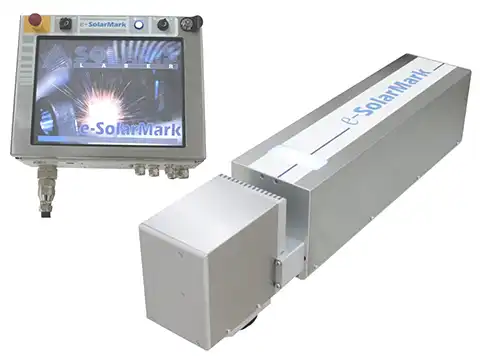
e-SolarMark+ DLG
e-SolarMark+ DLG is a cutting-edge laser marker in the green spectrum with low heat exposure, operating at a 532 nm wavelength.
With 10 watts of laser power, this DPSS laser 532 nm delivers markings with superior speed and contrast sharpness. It is ideal for surfaces that are challenging to mark with other wavelengths including plastics, reflective metals, steel, and ceramics.
Overview
keyboard_arrow_downYour challenges
keyboard_arrow_downOur solutions
keyboard_arrow_downKey benefits
keyboard_arrow_down- High-contract and traceable markings.
- Minimal heat transfer to the surface preventing substrate damage or perforation.
- Indelible marks that protect against counterfeiting.
- Compact and modular design, high integration flexibility due to several options.
- No added costs for consumables or external air means you gain higher line efficiency and lower operating expenses.
- The e-SolarMark+ DLG is clean, sustainable, compliant, and virtually maintenance-free. Industry 4.0 ready.
- Remote control and data transfer via network (LAN/Ethernet), serial (RS232), USB, and user binary signals.
Industries
keyboard_arrow_downMaterial types
keyboard_arrow_downTechnical specifications
keyboard_arrow_down| Laser type | DPSS, power from 5 W to 10 W |
| Wavelength | 532nm |
| Electrical requirements | 115V / 230V , 50/60Hz, 1PH - Auto |
| Marking field | From 100x100mm to 150x150mm |
| Input/Output Signals | Encoder, Product sensor, Safety interlock, Power, Shutter, READY / MARKING / FAULT |
| Cooling | Integrated air cooling with dust protection |
| Ambient temperature | 10-40°C; Suggested 15-30°C |
| Humidity | Up to 90%, non-condesing |
| Enclosure | IP 52 / NEMA 12 |
| Weight | Control Unit 16kg; Marking Unit 13kg |
| Communication | RS 232 / USB / Ethernet 10 Base T |
| Fonts | Multilanguage, Unicode |
| User interface | Multilanguage 15-inch touch screen with user-friendly interface for Preview, Edit& New jobs creation, and System setup |
Related products
e-SolarMark+ eFLS
e-SolarMark+ eDLV
What is DPSS laser technology?
Diode-pumped solid-state (DPSS) lasers are a type of solid-state laser where a diode laser optically pumps a laser crystal to produce a concentrated and coherent beam of light, which can be focused onto a substrate to create permanent markings. DPSS lasers are widely used in various industries due to their precision, efficiency, and versatility. Unlike UV lasers, DPSS lasers emit in the near-infrared or visible spectrum and have been highly effective in fast-moving consumer goods (FMCG) sectors as well as other industries.
One of the primary advantages of Solaris Laser DPSS laser coding is its ability to produce high-quality, crisp, and precise marks. This is especially important in the FMCG industry, where the legibility and clarity of barcodes, serial numbers, expiration dates, and other essential information are crucial. DPSS lasers have a high beam quality, which results in a small spot size and high energy density. This allows for fine, detailed marks on various materials, such as metals, plastics, ceramics, and composites, making them highly versatile for various industries.
For FMCG applications, DPSS lasers can mark on packaging materials such as PET, glass, cardboard, and metal foils. In other industries, like automotive, electronics, and medical devices, these lasers can be used for marking metals, ceramics, and some plastics. This adaptability means that a single DPSS laser coding machine can be employed across different product lines and materials, reducing the need for multiple types of equipment.
The permanence and durability of Solaris Laser DPSS laser markings are significant benefits, especially in industries where the markings must withstand harsh environments. Unlike ink-based marking methods, which can fade, smudge, or wear off over time, laser markings created by DPSS systems are resistant to abrasion, chemicals, and extreme temperatures. This makes DPSS laser coding also ideal for industries that require long-lasting marks, such as automotive parts manufacturing, aerospace, and electronic component production.
DPSS laser coding is non-contact, meaning the laser beam does not physically touch the product surface. This reduces the risk of damage to delicate or sensitive materials and eliminates the wear and tear associated with mechanical marking methods. The non-intrusive nature of DPSS lasers ensures that the integrity of the product is maintained, which is particularly important in the packaging of FMCG goods and in the medical device industry, where surface quality is critical.
Solaris Laser DPSS lasers for increased productivity
DPSS lasers offer high-speed marking capabilities, making them suitable for high-volume production environments. The FMCG industry, in particular, benefits from this speed, allowing manufacturers to mark products quickly without slowing down production lines. The fast marking speeds also mean that Solaris Laser DPSS laser systems can handle large batches with minimal downtime, improving overall equipment effectiveness (OEE) and reducing lead times.
DPSS laser coding has significantly lower operating costs compared to other traditional marking methods. There are no consumables like inks or solvents, and the maintenance required for DPSS lasers is minimal due to their robust and reliable design. The solid-state nature of DPSS lasers means fewer moving parts, reducing the likelihood of mechanical failure. This results in lower total cost of ownership (TCO) and fewer disruptions to production due to maintenance requirements.
Furthermore, DPSS lasers do not produce any by-products, reducing the risk of contamination, which is crucial in industries like food and beverage, pharmaceuticals, and electronics. It also makes them an attractive option for companies looking to reduce their environmental footprint and comply with increasingly stringent environmental regulations. In addition, the low noise levels associated with DPSS laser systems contribute to a more comfortable working environment.
Solaris Laser DPSS laser coding systems offer high flexibility and customization options, allowing manufacturers to easily switch between different marking formats, sizes, and styles. This flexibility is particularly useful in the FMCG sector, where packaging and product designs frequently change to meet market demands or regulatory requirements. The ability to quickly adjust laser settings without changing hardware components ensures a faster and more seamless transition between different products or packaging types.
DPSS laser coding systems can be easily integrated into automated production lines, enabling seamless coordination with other manufacturing processes. This integration capability allows for real-time data processing, quality control, and feedback, enhancing overall production efficiency. In industries where traceability is critical, Solaris Laser DPSS solutions offer a reliable solution for creating unique, tamper-proof markings that cannot be easily altered or replicated with the precision and permanence of the markings making them ideal for anti-counterfeiting measures.
Many industries, including FMCG, pharmaceuticals, aerospace, and automotive, have stringent regulatory requirements for product labeling and traceability. DPSS laser coding meets these standards by providing high-resolution, legible markings that remain intact throughout the product's life. This compliance is essential for manufacturers who need to ensure their products meet both domestic and international regulatory standards, such as those set by the FDA, ISO, or CE.
